

Choosing the right Quran teacher is an important responsibility for Muslim parents. Whether your family lives in the United Kingdom, United States, Canada, Australia, or elsewhere, finding a knowledgeable and patient teacher can help your child develop accurate Quran recitation skills and a meaningful connection with Islam.
However, with many online Quran academies offering lessons worldwide, parents often wonder: How to choose an online Quran teacher for your child who can provide reliable, age-appropriate Islamic education?
The answer begins with a simple checklist. Check the teacher’s qualifications, experience with children, teaching approach, communication skills, and lesson arrangements. A suitable teacher should understand your child’s current ability, explain concepts clearly, correct mistakes patiently, and provide opportunities for steady improvement.
Parents should also observe an actual lesson before making a long-term commitment. A free trial can help determine whether the teacher’s methods suit their child’s learning needs.
Islam places great importance on acquiring knowledge from reliable sources. Allah (SWT) says:
فَسْـَٔلُوٓا۟ أَهْلَ ٱلذِّكْرِ إِن كُنتُمْ لَا تَعْلَمُونَ
Meaning: “Ask those who possess knowledge if you do not know.”
Surah An-Nahl (16:43), .
Although this verse addresses a particular matter concerning earlier messengers, it also reminds readers of the importance of consulting knowledgeable people.
For Quran education, parents should therefore look beyond promotional claims and carefully evaluate a teacher’s knowledge, experience, and ability to support their child.
1. Check Qualifications and Experience When Choosing an Online Quran Teacher
A knowledgeable Quran teacher should understand correct recitation and know how to explain it according to the student’s learning level. While formal qualifications can be useful indicators, parents should also consider practical teaching ability, relevant experience, and the teacher’s approach to young learners.
Verify Quran Teaching Qualifications and Knowledge
Before enrolling your child, ask the academy about the teacher’s educational background, Quran recitation training, and experience in teaching Tajweed. Depending on the course, relevant preparation may include studies in Quran recitation, Tajweed, memorization, or recognized Islamic educational programs.
For advanced Tajweed or Hifz instruction, parents may also ask whether the teacher holds relevant certification, such as an Ijazah, and what that certification covers. Not every beginner-level teacher needs the same credentials, but the academy should be able to explain why the teacher is qualified to teach the proposed course.
A practical question is: “What training has this teacher completed, and how do you evaluate their Quran recitation and teaching ability?”
Parents should seek specific, verifiable answers rather than relying only on general descriptions such as “expert” or “highly qualified.”
Match Teaching Experience With Your Child’s Learning Level
A teacher who works effectively with older students may not necessarily be the best choice for a young beginner. Children need age-appropriate explanations, manageable lessons, and sufficient encouragement.
For example, a six-year-old learning Noorani Qaida may need help recognizing Arabic letters and understanding Fathah, Kasrah, and Dammah. Meanwhile, a twelve-year-old who already reads the Quran may require guidance with Tajweed, fluency, or memorization revision.
Parents should ask: “Have you taught children of a similar age and Quran reading level? How would you plan the first few lessons?”
A thoughtful teacher should be able to describe an appropriate starting point after assessing the child’s ability.
Compare Online Quran Teachers Fairly
When comparing teachers, consider their ability to meet your child’s needs rather than judging them solely by qualifications, lesson prices, or years of experience.
Imagine two teachers offering beginner Quran lessons. The first has extensive recitation knowledge but moves quickly through the material. The second also demonstrates suitable knowledge but explains individual Arabic sounds carefully and allows a young student time to repeat them.
For a child who struggles with pronunciation, the second approach may be more appropriate, even if both teachers possess relevant qualifications.
A fair comparison should focus on the quality of instruction, the child’s response, and whether the teacher offers a realistic learning plan.

2. Observe a Trial Lesson Before Choosing an Online Quran Teacher
A trial lesson provides parents with an opportunity to observe how a teacher communicates and responds to their child. Rather than focusing only on how much material is completed, parents should consider whether the lesson encourages understanding, correct pronunciation, and confidence.
Look for Clear Explanations and Patient Corrections
During a Quran lesson, the teacher should explain concepts in language the child can understand. For beginners, this may involve introducing Arabic letters, demonstrating their pronunciation, or explaining basic vowel marks before moving to complete Quranic words.
A suitable teacher should correct mistakes respectfully and allow sufficient time for repetition. If a child struggles to pronounce a letter, the teacher can demonstrate the sound, explain its articulation, and encourage another attempt.
Parents should observe whether corrections are specific and helpful rather than simply repeated without explanation.
The Holy Quran emphasizes measured recitation:
وَرَتِّلِ الْقُرْآنَ تَرْتِيلًا
Meaning: “And recite the Quran in a measured manner.”
Surah Al-Muzzammil (73:4)
This guidance highlights the importance of careful Quran recitation, an objective that should remain central to Tajweed instruction.
A Practical Example of Effective Quran Teaching
Consider a hypothetical online Quran lesson in which an eight-year-old child repeatedly confuses the Arabic letters ح and ه.
Instead of asking the student to repeat the letters without explanation, the teacher demonstrates both sounds, explains how they differ, and asks the child to listen carefully. The teacher then encourages the student to pronounce each letter separately before attempting a short word.
If the child continues struggling, the teacher slows the lesson and provides additional practice rather than moving ahead immediately.
This example demonstrates the value of patient correction, clear explanations, and teaching at an appropriate pace.
Parents should also notice whether the teacher invites questions and responds positively when the child needs help.
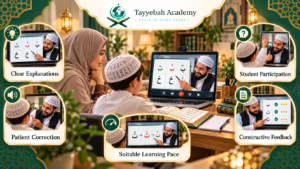
Five Things Parents Should Observe in a Trial Class
A trial lesson should help parents understand whether the teacher is a suitable match for their child. Use the following checklist:
- Clear explanations: Does the teacher explain Arabic letters and Tajweed concepts in understandable language?
- Patient correction: Are pronunciation mistakes corrected respectfully, with opportunities to try again?
- Suitable learning pace: Does the teacher adjust the lesson according to the child’s understanding?
- Student participation: Is the child encouraged to recite, ask questions, and actively participate?
- Constructive feedback: Does the teacher explain what the child has learned and what requires further practice?
Parents should remember that a quiet child may need time to become comfortable with a new teacher. A single lesson is useful evidence, but it should not be treated as a complete assessment of future progress.
3. Evaluate Communication, Scheduling, and Academy Policies
The right online Quran teacher should offer more than accurate recitation instruction. Parents also need dependable communication, manageable lesson arrangements, and clear information about fees and academy policies. These practical considerations are especially important for international families managing different time zones and school schedules.
Ask How Student Progress and Parent Feedback Are Managed
Regular communication allows parents to understand their child’s learning journey and provide appropriate support at home.
Before enrolling, ask how the teacher evaluates recitation accuracy, identifies areas for improvement, and recommends revision between lessons.
For example, if a child has difficulty applying a particular Tajweed rule, useful feedback might identify the rule, demonstrate a correct example, and recommend a short practice exercise for the coming week.
Parents should ask: “How will I know whether my child is progressing, and how frequently will I receive feedback?”
An academy may use verbal updates, written reports, assessments, or another method. The important consideration is whether the process is clear and suitable for the family.
Confirm Class Timings, Fees, and Teacher Availability
Online Quran classes are particularly useful for Muslim families living in countries where local Quran education may be difficult to access.
However, flexible scheduling should not be confused with guaranteed availability at every requested time.
Parents should confirm the available lesson times in their own time zone, class duration, weekly frequency, monthly fees, accepted payment methods, and procedures for missed or rescheduled lessons.
It is also important to ask whether the same teacher will normally conduct the lessons and what happens if that teacher becomes unavailable.
A useful question is: “If my child’s schedule changes or the assigned teacher is unavailable, what options can the academy offer?”
Parents should request the academy’s current terms directly before enrolling, because availability, teacher changes, refunds, and rescheduling arrangements can differ between providers.
Explore Tayyebah Academy’s Teaching Approach Through a Free Trial
At Tayyebah Academy, we aim to make Quran education accessible to Muslim children and families worldwide through live online learning.
Our academy offers male and female Quran tutors, one-to-one lessons, and flexible scheduling options. Courses include Noorani Qaida, Quran Recitation, Tajweed, Hifz Quran, Stories of the Prophets, and the Six Kalmas.
Tayyebah Academy also advertises a three-day free trial for prospective learners. Parents can use this opportunity to observe the teaching approach, discuss their child’s current Quran reading level, and consider whether the lessons are suitable.
Before confirming ongoing classes, families should ask the academy to clarify current fees, available schedules, teacher assignments, and applicable enrollment conditions.
A trial is not simply an opportunity to experience an online class. It is also a chance for parents to assess whether the learning environment encourages correct pronunciation, active participation, and respectful communication.
Final Thoughts: Choose an Online Quran Teacher With Care
Understanding how to choose an online Quran teacher for your child begins with evaluating knowledge, teaching experience, patience, and communication. The best choice is not necessarily the teacher who completes lessons fastest, but one who understands the learner’s needs and supports accurate, confident recitation.
By asking thoughtful questions, observing lessons, and reviewing practical arrangements, parents can make a more informed decision about their child’s Quran education.
Explore Online Quran Lessons With Tayyebah Academy
Give your child the opportunity to experience supportive online Quran learning before making a long-term decision.
Book Your Three-Day Free Trial With Tayyebah Academy
Helping children learn the Quran with knowledge, patience, and confidence.
Explore our other blogs
Tajweed for Beginners: A Practical Starting Guide
5 Signs Your Child Needs Better Quran Guidance
Top 7 Benefits of Learning Quran Online