
Islam is one of the world’s major religions, followed by over a billion people across the globe. The Muslim population has been growing steadily over the past decades and is projected to continue increasing. In this blog, we will examine the current statistics, the global distribution of Muslims, the reasons behind population growth, and what the future holds.
📊 Global Muslim Population: The Numbers
As of 2025, the estimated global Muslim population is approximately 2 billion people, accounting for around 25% of the world’s population. 🌐
🔹 Islam is the second-largest religion in the world after Christianity.
🔹 According to Pew Research Center, Islam is also the fastest-growing major religion globally.
🔹 By 2050, it is predicted that Muslims will make up 30% of the world’s population.
🌏 Where Do Muslims Live?
Muslims are not limited to one country or continent. They live all over the world, from Asia to Africa, and from Europe to the Americas. Let’s take a look at the regions with the largest Muslim populations:
1️⃣ Asia-Pacific Region
🌐 Nearly 62% of the world’s Muslims live in the Asia-Pacific region.
📍 Countries like Indonesia 🇮🇩, India 🇮🇳, Pakistan 🇵🇰, and Bangladesh 🇧🇩 have the largest Muslim populations.
- Indonesia is the country with the largest number of Muslims in the world, with over 230 million followers of Islam. 🕌
- Pakistan has around 240 million people, with Muslims making up 96% of the population.
- India has over 200 million Muslims, making it the third-largest Muslim population in the world, even though Muslims are a minority there.(Pew Research on India’s Muslims)
2️⃣ Middle East and North Africa (MENA)
🌍 Around 20% of the world’s Muslims live in this region.
📍 Countries like Saudi Arabia 🇸🇦, Iran 🇮🇷, Iraq 🇮🇶, and Egypt 🇪🇬 are part of this group.
- Islam originated in this region, particularly in Makkah and Madinah in Saudi Arabia.
- Most people in this region are Muslims, and the religion plays a major role in politics, culture, and daily life.
3️⃣ Sub-Saharan Africa
🌍 About 16% of the world’s Muslim population resides in this part of Africa.
📍 Countries like Nigeria 🇳🇬, Ethiopia 🇪🇹, and Sudan 🇸🇩 have significant Muslim communities.
- In Nigeria, Islam is one of the two major religions.
- Many West African countries have rich Islamic traditions dating back centuries.
4️⃣ Europe
🌍 Europe is home to around 5% of the world’s Muslims.
📍 Countries like Turkey 🇹🇷, France 🇫🇷, Germany 🇩🇪, and Russia 🇷🇺 have sizable Muslim populations.
- In France, there are over 6 million Muslims.
- Germany has around 5 million Muslims, many of whom are of Turkish origin.
- Islam is one of the fastest-growing religions in Europe.
5️⃣ North and South America
🌎 The Americas have a smaller Muslim population, but it is growing.
📍 The United States 🇺🇸 and Brazil 🇧🇷 have the largest Muslim populations in the Americas.
- The U.S. has approximately 3.5 million Muslims.
- Most American Muslims are highly educated and contribute to various sectors like medicine, education, and business. (Pew – Muslims in America)
🚼 Why Is the Muslim Population Growing?
There are several reasons why the Muslim population is growing rapidly:
🍼 1. High Birth Rates
Muslim-majority countries often have higher fertility rates compared to other regions. Families with more children naturally lead to population growth.
⏳ 2. Young Population
Muslims tend to have a younger median age, meaning there are more people in childbearing years, which leads to more births.
✈️ 3. Migration
Many Muslims have migrated to other countries for better opportunities, especially to Europe and North America. This helps spread Islam to new regions.
💍 4. Conversion
Although not a major factor compared to birth rates, conversions to Islam do happen across the world, especially in Western countries.
🕋 Diversity in the Muslim World
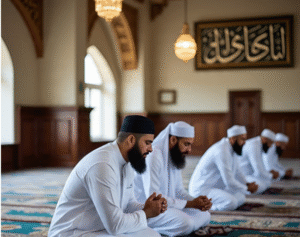
Islam is a universal religion that transcends ethnicity, language, and culture. The Muslim world is incredibly diverse:
- 🌐 Muslims speak hundreds of different languages.
- 🧕 You’ll find Muslims of all races – from Arab and African, to Asian, European, and Latino backgrounds.
- 📿 Some are Sunni, others are Shia, while smaller groups include Sufis, Ibadi, and others.
Despite cultural differences, the core beliefs of Islam – belief in one God (Allah), the Prophet Muhammad ﷺ, the Quran, and the Five Pillars – unite all Muslims. (Britannica – Five Pillars)
🧭 Muslims in Non-Muslim Countries
Islam is growing in non-Muslim majority countries as well. Many Muslims live as minorities in countries where they contribute to society while maintaining their religious identity.
🔹 In India, Muslims are the largest religious minority.
🔹 In Europe, Muslims play an important role in industries, sports, education, and politics.
🔹 In the U.S., Muslims are business owners, teachers, doctors, and engineers.
Despite challenges such as Islamophobia and discrimination, Muslims continue to thrive and grow as part of the global community.
🔮 The Future of the Muslim Population
According to demographic projections:
- By 2050, Islam may become the world’s largest religion, surpassing Christianity.
- Muslim populations are expected to double in countries like Nigeria and India.
- The number of Muslims in Europe and North America is expected to rise due to migration and natural growth.
This growth highlights the importance of interfaith dialogue 🤝, mutual respect, and understanding diversity.
💡 Interesting Facts
📌 The Quran has been translated into more than 100 languages.
📌 Friday (Jumu’ah) is considered a holy day in Islam.
📌 Ramadan, the holy month of fasting, is observed by Muslims around the world – from Alaska to South Africa. 🌙
📌 Muslim holidays such as Eid al-Fitr and Eid al-Adha are celebrated with joy and charity. 🎉
✨ Conclusion
The Muslim population in the world is not just growing in numbers but also in influence. Islam is present in every corner of the globe, shaping cultures, economies, and communities. From the deserts of the Middle East to the cities of Europe and the villages of Africa, Muslims are contributing to the world in countless ways.
As we move forward, it’s important to recognize the richness of Islamic culture, the values it promotes, and the diversity of its followers. Understanding the global Muslim population helps us build a more peaceful, inclusive, and respectful world. 🤲🌍
Want More Like This?
If you found this blog helpful, explore more soul-strengthening reads: